
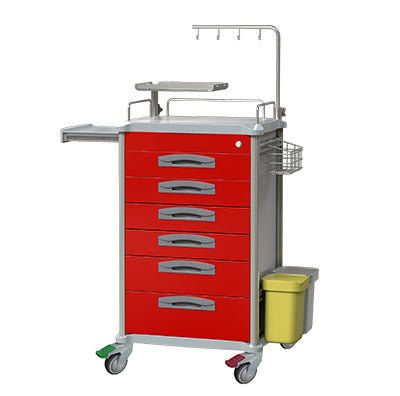
R6 Emergency Crash Cart
Designed for ICU and emergency-department use.
View R6 →
Plan readiness checks, inventory sensing, alerts and audit records around the hospital’s emergency-cart policy.
Discuss crash cart requirementsTechnology can support readiness, but it does not replace clinical governance or required manual verification. Start with the approved cart contents, checking responsibility, seal process, defibrillator test and escalation policy.
Options include tamper-seal status, drawer-open sensing, RFID or barcode inventory, temperature monitoring, cart location and interfaces to compatible equipment. Confirm which signals are technically available from each defibrillator model before specifying automation.
Specify local operation, event storage and resynchronisation during network loss. Use managed identities, protected audit logs, segmented connectivity and a documented software-update process.
Assess structural condition, drawer geometry, power, sensor installation, cleanability and warranty. A retrofit may be suitable for some fleets, while a purpose-configured cart can simplify integration. Validate both using the same acceptance criteria.
These are live crash-cart products. Any smart monitoring or sensor configuration should be confirmed separately for the project.
Designed for ICU and emergency-department use.
View R6 →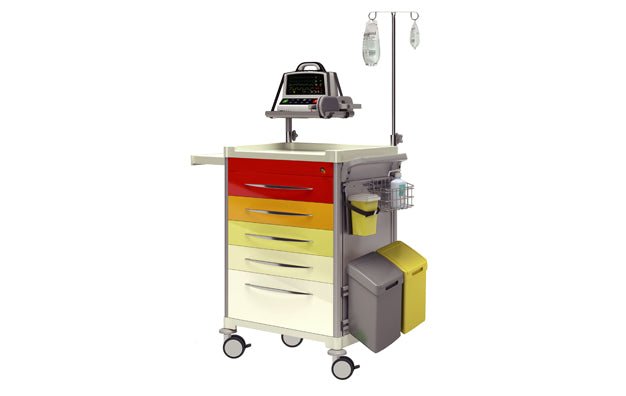
Compare a modular emergency-storage format.
View R-BOX →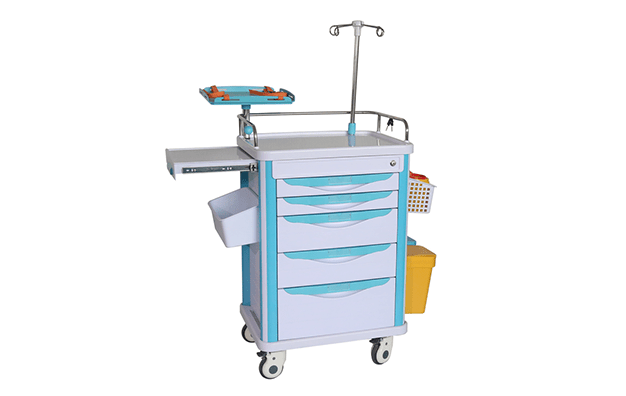
Provides organised clinical storage for emergency response.
View product →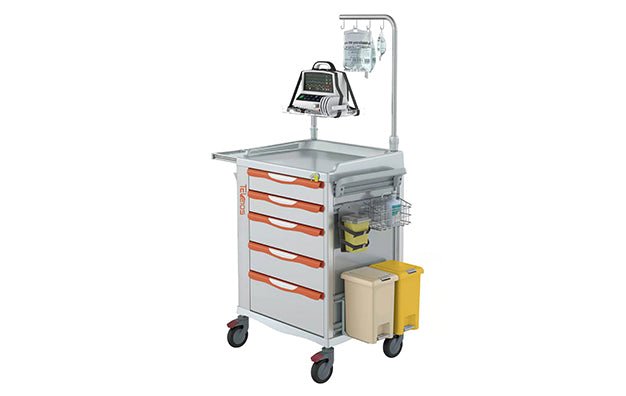
Review for resuscitation-equipment storage requirements.
View product →Sometimes. Feasibility depends on drawer construction, power, cleaning, sensor placement and the desired monitoring scope.
Only if each item carries a suitable identifier and the configured reader reliably detects it. Test the exact packaging.
Specify local status, alert behaviour, event storage and later synchronisation. Do not rely solely on a remote dashboard.
Only where the specific device exposes a supported interface and the integration is validated with its manufacturer.
This requires a compatible location system, mapped facility zones and an agreed update frequency.
No. The hospital must decide which checks can be supported electronically and which clinical or regulatory checks remain manual.
Share your cart fleet, checklist and desired monitoring scope with Rife Medical.
Request consultationWe are on hand to quickly give you pricing, more information, or help choose the right medical furniture, cart, cabinet, or storage solution for your requirement.