
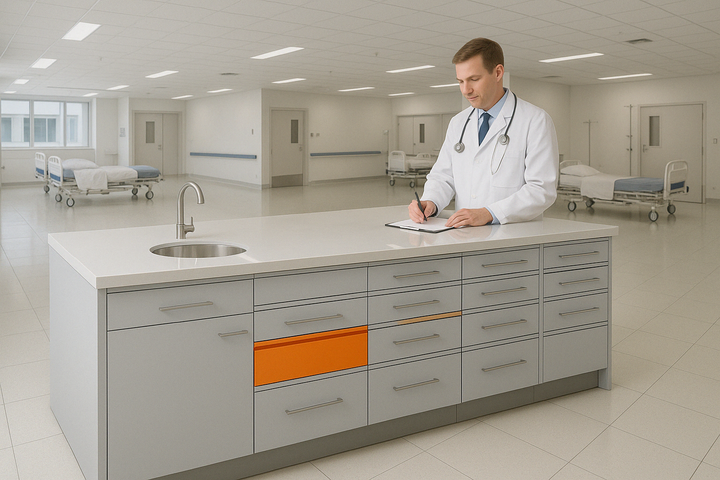
Multi-Purpose Modular Storage Cabinet with Sink and Drawers
A modular clinical cabinet and work-surface configuration.
View product →
How to choose the right balance of speed, flexibility, workflow fit and lifecycle support.
Discuss your requirementThe decision is rarely all-modular or all-custom. Many hospitals get the best result from standard, serviceable modules with limited customisation at the points where clinical workflow or room constraints genuinely require it.
Modular cabinets use repeatable sizes, components and accessories. They can shorten design time, simplify future changes and make replacement parts easier to manage. Their success depends on a module family that fits the room and workflow.
Custom cabinetry is designed around a particular space, item set or clinical process. It can use awkward areas efficiently and solve specialised needs, but design approval, lead time, validation and future alterations require more planning.
Assess design effort, installation disruption, cleanability, service access, spare parts, relocation potential and future reconfiguration. A low initial quote may be expensive if a damaged component cannot be replaced or a layout cannot adapt.
Start with standard carcasses, drawers, shelves and locks. Customise only interfaces such as worktops, service penetrations, special trays or room-end panels. This preserves much of the modular system's serviceability while addressing real constraints.
Choose modular when flexibility, repeatability and rollout speed dominate. Choose custom when a verified clinical or architectural constraint cannot be met safely by standard modules. Record the reason for every custom element.
A modular clinical cabinet and work-surface configuration.
View product →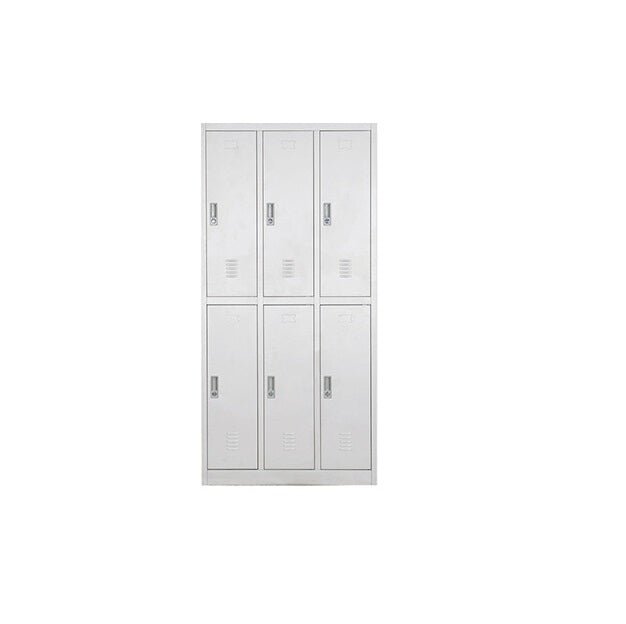
A standard enclosed cabinet option for medical storage.
View product →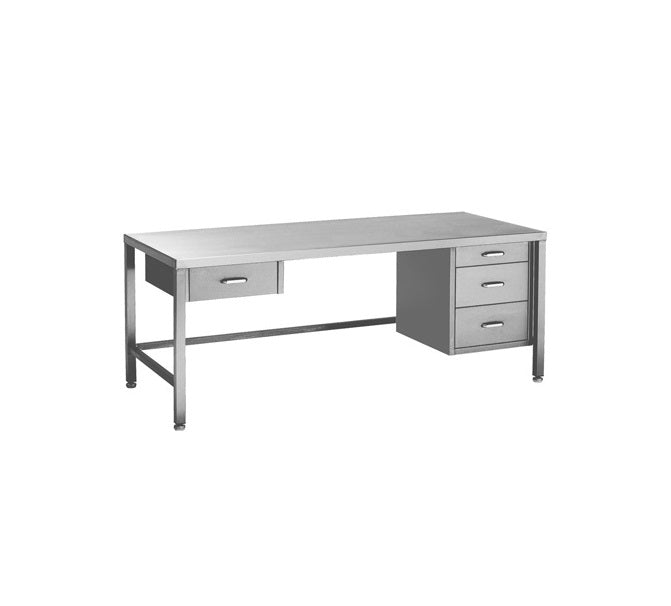
A stainless-steel work surface for compatible processing layouts.
View product →Not always, but it usually carries more design, approval and future-change risk. Compare total installed and lifecycle cost.
Often, using fillers, end panels or limited custom worktops. A measured room survey is essential.
Standard modules are generally more predictable, but site readiness and project scale can matter more than the cabinet type.
Many can, provided the product family and spare parts remain available. Confirm exactly which components are field-changeable.
Examples include unusual equipment, constrained services, specialised workflows or dimensions that standard modules cannot safely serve.
Prototype the highest-risk or most repeated bay with real stock, cleaning methods and intended users.
Ask Rife Technologies to compare a standard, hybrid and custom configuration against your room survey and clinical item list.
Request consultationWe are on hand to quickly give you pricing, more information, or help choose the right medical furniture, cart, cabinet, or storage solution for your requirement.